News Article Count: 0
Economy News Article Count: 46
Politics News Article Count: 33
Sports News Article Count: 21
Food & Drink News Article Count: 23
Peruvian Curiosities Article Count: 14
Living & Lifestyle News Article Count: 33
Nature & Environment News Article Count: 18
Safety & Security News Article Count: 15
Travel News Article Count: 35
Technology & Science News Article Count: 12
Travel Destination Article Count: 18
Editors' Opinion Article Count: 8
Uncategorised Article Count: 5
Support Article Count: 9
Multimedia Article Count: 2
Events & Entertainment Article Count: 100
Food & Drink Article Count: 17
Peru Information Article Count: 5
Peruvian Visa Types Article Count: 8

Peru is a very welcoming country and allows citizens of numerous countries to visit for touristic and recreational purposes without a visa. But as soon as you are planning to do business in Peru, study, work, settle or retire in the country, Peruvian law stipulates to have the appropriate visa for it.
Peru offers a sometimes quite confusing amount of different visa types. To make the whole Peruvian visa system more transparent and easy to understand for foreigners, we compiled a number of articles dedicated to the most important and used visas.
In general Peru distinguishes between temporary visas and resident visas.
Peruvian temporary visas
Temporary visas are intended for short-term stays in Peru. These include:
- the tourist visa
- the temporary student visa
- the volunteer visa
- the business visa
- the temporary work visa
Visitors can apply for a temporary visa at a Peruvian embassy or consulate in the country of their residence (in case of the tourist visa, if necessary). If there is no Peruvian diplomatic mission in your country of residence, please read here on how to proceed. A listing of all Peruvian embassies and all Peruvian consulates abroad sorted by continents can be found on the website of the Peruvian Ministry of Foreign Affairs (don’t miss the little arrows under each section to see more results).
Peruvian resident visas
Resident visas however are for long-term stays in Peru. They include:
The Peruvian diplomatic missions abroad don’t issue residence visa anymore; these must be applied for in Peru. So, visitors planning a longer stay in Peru and being able to meet the requirements for one of the resident visas, enter the country as tourists and then change their immigration status at the Peruvian immigration authority Migraciones.
Peru Advice & Security Series Article Count: 13

Most travelers planning a trip to Peru, have already heard or read good meant warnings and tips about the safety and security situation in the country before even exiting the plane. Once in Peru even locals might warn about dangers lurking around every corner.
Most travelers planning a trip to Peru, have already heard or read good meant warnings and tips about the safety and security situation in the country before even exiting the plane. Once in Peru even locals might warn about dangers lurking around every corner.
Although crime is present in Peru and cannot be argued away, most (though not all) warnings are unfounded; often potential risks are hopelessly exaggerated and fears unnecessarily fueled.
To give Peru travelers and newly arrived expats a comprehensive overview of the actual situation in the country, we are covering every conceivable aspect regarding safety and security including useful travel tips in our new series "Travel Tips and Safety Advice for Peru".
International Schools Colleges Article Count: 21
Top Universities in Peru Article Count: 3
A guide to higher-education in Peru

Peru probably isn’t the first country crossing your mind when considering to study abroad. At least partly unjustly. The country, and here especially Lima, has a few excellent and well-respected, public and private higher-education institutions which constantly rank among the Top 100 universities in the region.
The universities we introduce you below are of course all officially accredited and recognized by the Peruvian Ministry of Education and offer courses and programs leading to officially recognized undergraduate and postgraduate degrees such as bachelor’s degrees, master’s degrees and doctorate degrees in several areas of study. These degrees obtained in Peru can be validated and recognized abroad – the process depends on regulations there.
Undergraduate studies take two years of general study and another couple of years of specialization. Master’s and doctoral level studies also take around two years each.
A lot of universities in Peru as well have close relations with universities and institutes around the globe ensuring not only higher education standards but as well easier knowledge and student exchange.
Academic calendar in Peru
The academic year in Peru is divided into two semester – a summer semester and a winter semester.
Most courses begin in the summer semester which depending on the university can start as early as January, but usually in March or latest April and end in June or July. The winter semester usually begins in August or September and ends in December.
Registration, payments, entrance exams and enrollment can be as early as 2 or 3 months before the semester starts. So, it’s advisable to check the dates with each university individually.
International students in Peru
International students that want to study a semester or two in Peru are usually welcome to apply for enrollment either as exchange student from universities abroad having a student exchange agreement with the university in Peru or as international visiting student, so students must arrange admission, courses, payments, etc. directly with the Peruvian university.
Other foreign students planning to do their course of studies completely in Peru have to go through the same application and admission process as Peruvians must.
Admission policy of Peruvian universities
The admission policies are determined by each university. So, procedures and requirements vary.
Most universities in Peru have a selective admission policy based on entrance examination – exception: if the student attended a “preferred” school in Peru (so a school that has a special agreement with the university) or took a special preparation course, or was the best of his / her class, he or she can get around it.
Nevertheless, all students have to register usually on the website of the university, pay a fee, submit some documents (such as school-leaving certificate when beginning the studies or other documents certifying the level of studies, ID copy, birth certificate, registration form, payment receipt, passport photos, …) and then most have to pass an exam.
Entrance exams at Peruvian universities
These exams vary from university to university, but usually contain multiple choice questions testing the student’s Spanish language skills, mathematical reasoning and sometimes knowledge in the area of chosen studies.
International students participating in an exchange program usually don’t have to go through the normal admission process as agreements between the universities simplify the temporal admission and therefore don’t have to pass an exam. International visiting students should get in contact with the chosen university in Peru to enquire about the process.
Languages at Peruvian universities
Generally speaking the language of instruction and conversation at Peruvian universities is Spanish.
While most universities don’t request an official Spanish language certificate, students must have an intermediate or advanced proficiency level to understand classes and assignments.
Certain courses and a few courses especially designed for international students are in English or other languages.
Costs of Peruvian universities
Fees to study at a university in Peru vary. In general, many universities charge per credit rather than per semester or year.
Each university no matter if public or private has a special system in place which determines the tuition. Factors influencing the costs include for example selected career and / or courses, number of semester credits and the socio-economic situation of the student.
Additionally, fees and costs for registration, materials, books and photocopies must be covered.
Be aware that most universities in Peru don’t offer international and foreign student’s scholarships or other financial aids.
List of top universities in Peru
Below you can find a for the moment short list of top universities in Peru. Click on the name of each university to open a detailed description page with information about the university itself, academic ranking, study areas & degree levels, admission process, international students and fees. Provided information should give you a general overview of each university and what they offer. For more details, check out the website of the university of your choice and get in contact with them.
Business Article Count: 5

The economic stability in Peru and the steady growth of the country has many foreign investors considering setting up their base here. More and more Peru with its capital Lima is developing into an important hub for the whole Latin America market. With a solid infrastructure in place that accommodates access to all mayor shipping lines, international and national airports it is connected literally to the whole world setting the scenario for a very interesting future.
Over the past decade the infrastructure in the main cities has improved dramatically even though certain rural areas still face issues with further development needs. The information provided in our Business & Investment Section should give you a good idea on what to expect with regards to the requirements and legal framework that you will face...
Legal Stuff Article Count: 9
History of Peru Article Count: 3
Peruvian history presents a fascinating example of cultural transfer, cultural clashes, and cultural transformations. In 1532 the western European culture of Spain collided with one of the most sophisticated and highly developed cultures of America: the culture of the Incas. Unlike their brothers in the endless plains of North America, the Incas survived the brutal impact of the Spanish conquest and colonization, and Peru became the cradle of a new mestizo race and culture. Spanish greed and Spanish idealism clashed in colonial Peru with the Incas stubborn need to survive and to preserve their cultural identity. After three centuries of struggle, the result was the birth of a nation that was neither Spanish nor Indian but a unique mixture of the two.
Before your eyes the history of Peru reveals the long and painful process by which two great cultures challenged each other and finally produced a new cycle in the cultural evolution. Imperial Spain and the Incan empire have long since disappeared, but modern Peru (child of the two) today stands confident on the threshold of the future.
People of Peru - Now and Then Article Count: 2
Four major groups of the human family have contributed to Peru's population: Amerindians, whites, blacks, and Orientals. The government traditionally described all mixtures of these stocks as "mestizo," although in everyday speech this term usually denoted the European-Indian amalgam most common in the country. Up until a century ago, Negroes were quite numerous, especially in Lima and other coastal areas. Intermixing, however, has nearly eliminated this group as a significant, visible component of the population.
Today, Blacks and Asians (primarily Chinese and Japanese) together account for less than 1 percent of the nation's inhabitants. Except for these two ethnic elements, racial labels are as much social and cultural designations as categories based upon physical features. Boundaries between the groups are imprecise; white merges into mestizo and mestizo into Indian. Ultimately, the racial term applied to an individual depends upon how the person perceives himself and is viewed by others. Peruvian perceptions of race, like beauty, are in the mind of the beholder.
Peruvian Public Holidays and Festivities Article Count: 50
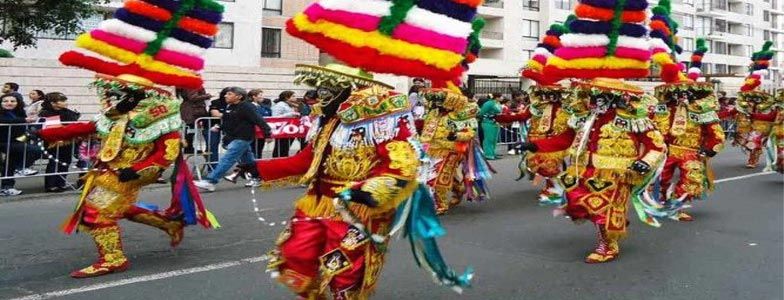
Peru’s official non-working public holidays include internationally celebrated days such as New Year, Easter and Christmas, church festivals in honor of Christian saints such as All Saints Day or Saint Rose Day, a day honoring the brave men of Peru’s military that fought in the Battle of Angamos (War of the Pacific in 1879) and of course Peru’s "Fiestas Patrias", a two day celebration for the country’s independence from Spain.
| Holiday - English | Festivo - Spanish | Date/Dates |
|---|---|---|
| New Year’s Day | Año Nuevo | 01 January |
| Holy Thursday | Jueves Santo | 18 April 2019 09 April 2020 01 April 2021 |
| Good Friday | Viernes Santo | 19 April 2019 10 April 2020 02 April 2021 |
| Easter Sunday | Pascua | 21 April 2019 12 April 2020 04 April 2021 |
| Labor Day | Dia del Trabajo | 01 May |
| St. Peter & Paul | Dia de San Pedro y San Pablo | 29 June |
| Peru’s Independence Day | Fiestas Patrias | 28 to 29 July |
| Saint Rose of Lima | Dia de Santa Rosa de Lima | 30 August |
| Battle of Angamos | Combate de Angamos | 08 October |
| All Saints Day | Dia de Todos los Santos | 01 November |
| Immaculate Conception | Dia de la Immaculada Concepcion | 08 December |
| Christmas Day | Navidad | 25 December |
On Christmas Eve and New Year’s Eve Peruvians employees usually only work half a day.
Furthermore, it is quite common in the public and private sector to have a "puente" (bridging day) if a public holiday is on a Thursday or Tuesday; meaning government agencies, offices, banks and lots of companies are closed on the Friday after / the Monday before the holiday and employees have off.
But no matter if it’s a public holiday, banking holiday, bridging day or weekend most supermarkets, fruit and veggie markets, the little bodega around the corner, restaurants, tourist attractions and other shops are open (some might have shorter opening hours especially on Christmas Day, New Year’s Day and during Fiestas Patrias).
Additionally to above mentioned official public holidays valid throughout Peru, there are numerous other local feast days, festivals and celebrations in different Peruvian regions and cities that have sort of "public holiday" character. They offer a good “excuse” to come together, celebrate, dance, have great Peruvian food and enjoy. Furthermore Peru has numerous "Días nacionales" (national days) or "Días de ..." (special days) on which the country honors or celebrates important events of the past, its culture, food or natural resources.